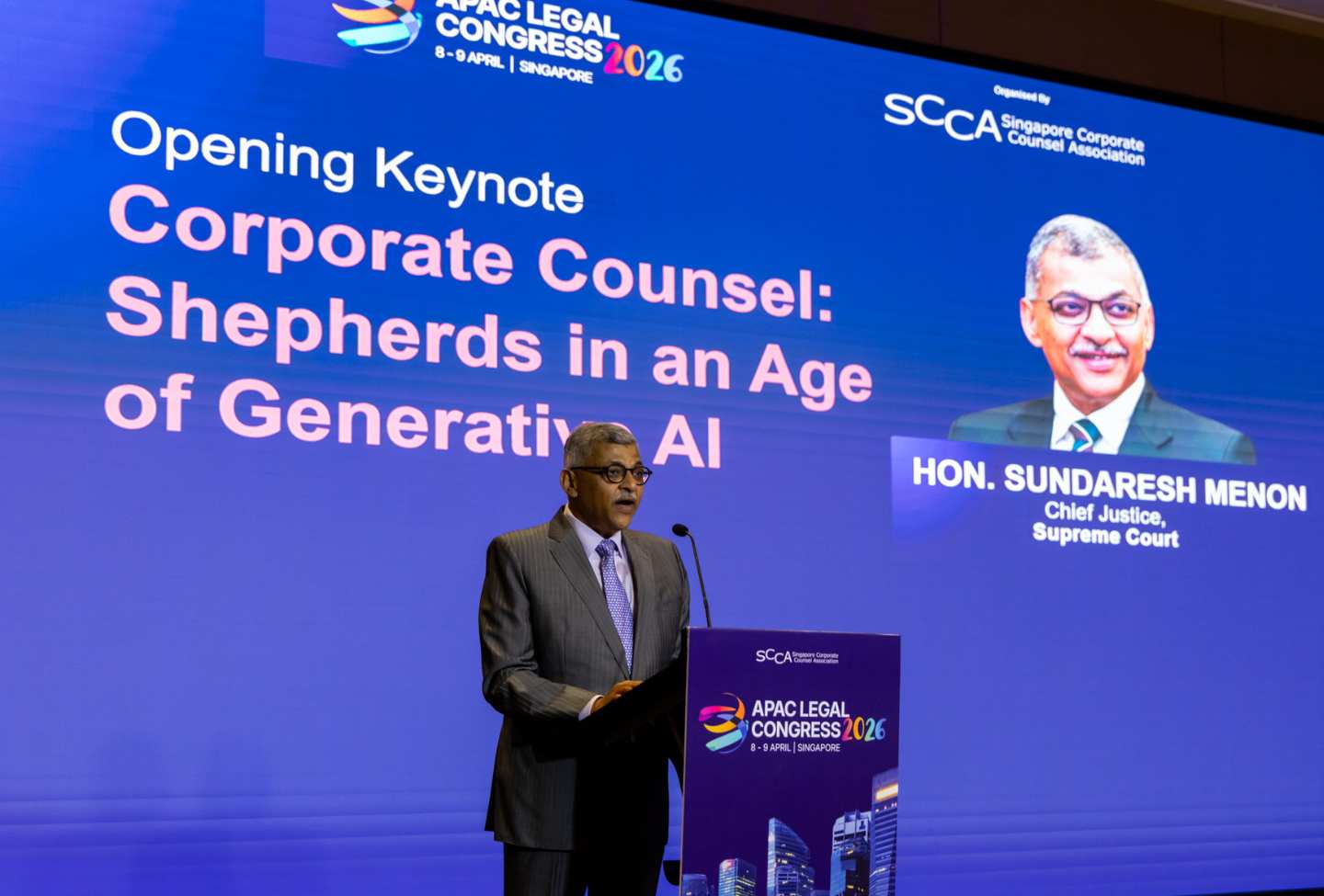
Grand Justice: In the era of dramatic changes brought about by AI, corporate lawyers should act as "shepherds" to guide businesses.

In his keynote address titled "Corporate Lawyers: Shepherds in the Age of Generative AI," the Chief Justice emphasized that artificial intelligence is no longer merely a tool, but rather a "versatile teammate"—an assistant that optimizes workflows and a coach that provides honest feedback. However, he stressed that in human-machine collaboration, humans must never relinquish their own judgment. (Provided by the Singapore Corporate Lawyers Association)

The rise of generative artificial intelligence does not signify the end of the legal profession, but rather marks the birth of a "completely new species of lawyer." Chief Justice Menon called on corporate lawyers to act as "shepherds" amidst this dramatic change, guiding businesses to navigate the age of artificial intelligence with stability.


The Singapore Corporate Lawyers Association (SCCA) held its fourth Asia Pacific Legal Conference on Thursday (April 9). In his keynote speech entitled "Corporate Lawyers: Shepherds in the Age of Generative Artificial Intelligence (Gen AI)," the Chief Justice emphasized that artificial intelligence is no longer just a tool, but more like a "versatile teammate," serving as both an assistant that can optimize workflows and a coach that can provide honest feedback. However, he stressed that in human-machine collaboration, humans must never abandon their own judgment.


He said that humans need to use their judgment to decide whether to adopt "autopilot mode" or become the "co-pilot" and "captain" in this transformation. In the age of artificial intelligence, this is precisely the role of corporate lawyers as "shepherds," neither hindering the development of enterprises (the flock) nor blindly forging ahead in rugged terrain, but providing enterprises with a sense of security, direction, and leadership amidst dramatic changes.


The legal profession faces three major pitfalls in applying artificial intelligence.


The Supreme Court Justice also pointed out three major pitfalls faced by the legal profession when applying artificial intelligence. First, the performance of AI varies greatly; while it may appear to perform legal reasoning, it may merely generate seemingly reasonable texts based on patterns, and cannot be equated with genuine human legal thinking.


Secondly, over-reliance on artificial intelligence leads to a loss of accountability. The adoption of AI aims to expand humanity's ability to perform higher-level, more impactful work, and must never be used as an excuse to abandon judgment.


The third risk is that the indiscriminate use of artificial intelligence may undermine the foundation for the growth of young lawyers. The legal profession has always relied on the "mentorship system," where young lawyers gradually accumulate professional intuition and experience through practical work and observation. However, the very daily work that lays the foundation is most easily replaced by artificial intelligence.


A survey reveals that the loss of professional skills is the industry's biggest concern regarding artificial intelligence. This not only affects the growth of individual lawyers but also the long-term development of the entire legal profession.


Artificial intelligence is changing the landscape of corporate risk.


The Supreme Court justices also pointed out that artificial intelligence is changing the risk landscape for businesses, which can be summarized by three "Ds." The first is Data: every interaction with an AI platform leaves a data trail, potentially impacting confidentiality privileges between lawyers and clients. The second is Duties: as businesses rely on AI for decision-making, the legal community must explore new management and oversight responsibilities, such as the prudent use and compliance monitoring of AI. The third is Displacement: knowledge workers face challenges, especially those just starting their careers. Predictions indicate that up to half of entry-level white-collar jobs may be replaced within the next one to five years, with the most significant job losses among younger employees in relevant industries.


In response to these challenges, the Supreme Court justices proposed three main strategies. First, as artificial intelligence enables the internalization of routine tasks, nearly two-thirds of corporate lawyers expect to reduce their reliance on external law firms, especially in handling routine matters such as contract drafting, litigation, and mergers and acquisitions. This will reshape the division of labor in the legal ecosystem.


Secondly, senior lawyers should let junior lawyers hone their basic skills manually, while combining structured feedback and internalization processes, and should also accept reverse guidance from "digital native" newcomers.


In addition, he emphasized that Singapore is actively building a responsible AI infrastructure, including the government’s plan to train 100,000 AI-bilingual employees by 2029, and the Ministry of Law’s recently released guidelines for the use of AI in the legal field.